The UK terrorism threat level has been raised to ‘severe’ in the wake of the double stabbings in Golders Green.
Officials announced today that the threat to Britain from all forms of terrorism has moved from ‘substantial’ to ‘severe’, meaning an attack is now highly likely.
The Joint Terrorism Analysis Centre (JTAC) made the decision after a series of attacks on the Jewish community in recent weeks, culminating in the double stabbing of two Jewish men in Golders Green yesterday.
The threat level was last assessed as severe in November 2021 following the Liverpool Women’s Hospital bombing when a failed asylum seeker detonated an improvised explosive device killing himself and injuring a taxi driver.
In February 2022, independent JTAC experts decided to lower the terror threat to ‘substantial’, meaning an attack is likely.
The threat level has not changed for the last four years, despite a series of terrorist incidents.
Home Secretary Shabana Mahmood has urged people to be ‘vigilant’ as she announced the change.

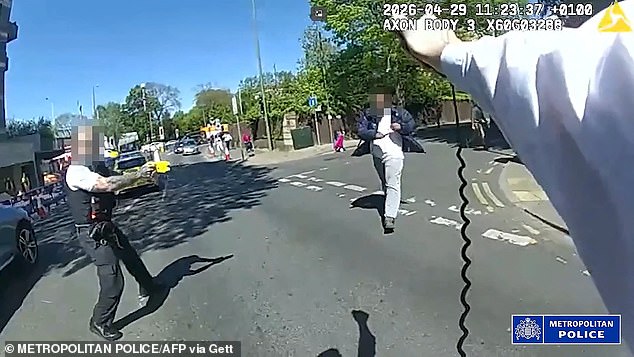
Police had to taser the knifeman in Golders Green after two Jewish people were stabbed in the terror attack. Both are now in a stable condition
Ms Mahmood said: ‘Yesterday’s abhorrent, antisemitic attack was a vile act of terrorism.
‘My thoughts today remain with the victims, and with the whole Jewish community at a time of deep disquiet and fear.
‘My deepest thanks go to the volunteers and emergency services, a number of whom I met today. Their actions saved lives and they are, and forever will be, heroes.
‘Today, the national threat level has increased to “severe”, which means a terrorist attack is considered highly likely.
‘I know this will be a source of concern to many, particularly amongst our Jewish community, who have suffered so much.
‘The Government has today announced a significant increase in investment to protect our Jewish communities, with record funding for policing and security at synagogues, schools and community centres. And we will do everything in our power to rid society of the evil of antisemitism.
‘As the threat level rises, I urge everyone to be vigilant, as they go about their daily lives, and report any concerns they have to the police. And I can assure everyone that our world-class security services and the police are working, day and night, to keep our country safe.’
Head of Counter Terrorism Policing Assistant Commissioner Laurence Taylor said police are seeing an ‘elevated threat to Jewish and Israeli individuals’ amid ‘an unpredictable global situation’.
He said: ‘As part of our review into the change in the threat level, policing will be reviewing all events across the country.
‘My teams will be working with forces to ensure that we have appropriate protective security measures in place, that the appropriate mitigations are put in place, and we will be engaged with communities who will be affected by large events, as well as those involved in the events, so that we can keep them safe as they can be.’
The news comes as the suspect in the Golders Green terror attack is still being quizzed in custody on suspicion of attempted murder.
The government outlines five different terror attack threat levels. The move to ‘severe’ is the second highest and means ‘an attack is highly likely’.
The only level above is known as ‘critical’, which means ‘an attack is highly likely in the near future’.
The JTAC work with MI5 in setting the threat levels which are regularly reviewed.
They are set based on available intelligence on terrorist capability, terrorist intentions and the timescale of the likelihood of the next attack.
The threat levels are ranked in five stages. Severe is the second highest, behind critical which means an attack is expected imminently.
Behind severe is substantial (an attack is a strong possibility), then moderate (an attack is possible but not likely), and low (an attack is unlikely).
Shloime Rand, 34, and Moshe Shine, 76, were allegedly stabbed by the knifeman but are now in a stable condition after being rushed to hospital. The attacker is also alleged to have tried to stab another man in his rampage in north London.
Locals directed their anger towards politicians following the attack today. Sir Keir Starmer was booed when he visited the scene at Golders Green today.
Crowds heckled the Prime Minister as he went past with chants of ‘Keir Starmer, Jew harmer’ and ‘traitor’ being struck up.
Fellow Left-winger, Green Party leader Zack Polanski was also slated for retweeting a post suggesting hero policemen who disarmed the terror suspect after he knifed two Jews had been too heavy-handed.
Today Mr Rand spoke from his hospital bed to reveal how he had been stabbed in the chest and claimed it is a ‘miracle’ he is alive.
But he also alleged that Sir Keir Starmer and his administration is ‘not doing its job’ to protect Jewish people in the UK, who he says are ‘afraid’ and ‘uncomfortable walking in the street’.
Asked whether he felt let down by the Government, he said ‘definitely’.
He said: ‘The Government, they are the ones that are able to take care of the problems. And they are not doing their job.
‘People are really concerned, people are afraid, people are uncomfortable walking in the street, people are blaming obviously the government for not doing anything about what’s going on.’
Police confirmed the suspect in Wednesday’s attack had previously been reported to Prevent, the Government’s anti-extremism programme.
The 45-year-old British national was born in Somalia and came to the UK legally as a child in the 1990s, Ms Mahmood has said.
The suspect has been named as Essa Suleiman, and Metropolitan Police confirmed he was referred to Prevent in 2020 – but the case was closed the same year.
The level was first made public in 2006. Since then, it has most often been at the severe level, and not been lower than substantial.
The critical level has been in place four times over the 20-year period.
It became critical first in August 2006, following a plot to detonate explosives on transatlantic flights.
Then the threat level increased again in June 2007 after an attempted car bomb attack at Glasgow Airport.
It was increased again in May and September 2017 after the Manchester Arena bombing and the Parsons Green District line attack, respectively.
The UK’s rating was downgraded to severe a few days after the Parsons Green incident and remained there until it was lowered to substantial in November 2019.
The last time the level was raised to severe was in November 2021 after two attacks in the space of a month, with a car explosion outside a Liverpool hospital on Remembrance Sunday and the murder of Conservative MP for Southend West Sir David Amess in October.
It was downgraded back to substantial in February 2022, where it had remained until today.
The JTAC reviews the terror level every six months but does not always raise it following attacks.
It considered increasing the level to severe just weeks after the downgrading in November 2019 after the London Bridge Fishmongers’ Hall attack but kept it at substantial.