Premier League formations once appeared relatively straightforward. Teams generally selected four defenders, four midfielders and two strikers, with individual quality often determining whether the system succeeded.
Modern formations are considerably more fluid.
A team listed in a 4-3-3 may build with three defenders, attack in a 2-3-5 and defend in a 4-4-2. Full-backs move into midfield, wingers become additional forwards and attacking midfielders lead the press alongside the striker.
The numbers shown before kick-off now describe only the starting positions. The real tactical picture depends on how the formation changes throughout the match.
The 4-3-3 remains the formation of control
The 4-3-3 is closely associated with teams wanting to dominate possession and control the centre of the pitch.
It provides three central midfielders, two wide attackers and a single striker. The positioning ideally creates passing triangles across the pitch, giving the player in possession several options.
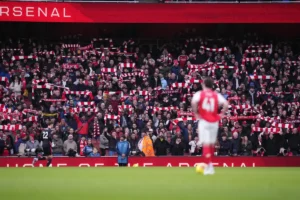
Arsenal provide one of the Premier League’s clearest examples. Their 4-3-3 allows Declan Rice to protect the defence or advance into wider areas, while the two wingers stretch the opposition. One full-back can move inside to create another midfield option.
This means the formation often becomes a 3-2-5 or 2-3-5 in possession. Five players occupy the attacking line, with the wingers maintaining width and the central attackers looking for spaces between defenders.
The system offers significant control but requires technically secure defenders. Losing possession with both full-backs advanced can leave only two or three players protecting a counterattack.
The 4-2-3-1 provides greater balance
The 4-2-3-1 has become one of the most common Premier League formations because it can accommodate a variety of styles.
Two deeper midfielders protect the defence, while a number 10 operates behind the striker. Wide players can remain near the touchlines or move centrally to create additional scoring threats.
The double pivot is central to the system. One midfielder may hold position while the other advances, or both can remain deeper against…
..