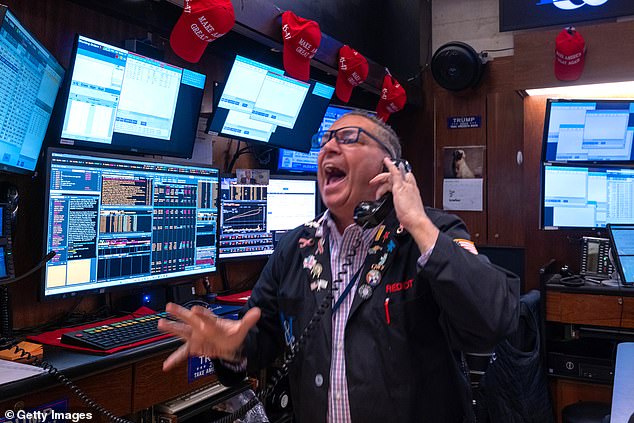
A Halloween slump in technology stocks has fuelled fears of a market crash that would hammer the savings and pensions of millions of British families.
On a brutal session in trading rooms in New York, the tech-heavy Nasdaq index followed up Thursday’s 1.4 per cent slide with a drop of more than 3 per cent on Friday.
Analysts warned of ‘tech carnage’ with shares in US giants Amazon and Intel among the biggest losers following bleak results on Thursday night.
Intel shares tumbled nearly 30 per cent – wiping around £90billion off its value – while Amazon fell more than 3 per cent.
The latest sell-off came after Google owner Alphabet tumbled more than 12 per cent on Thursday night – wiping close to £400billion off its value.
The tech titan, one of the so-called Magnificent Seven, is now down 30 per cent since its peak in May while the Nasdaq is off 7.5 per cent – wiping £2.5trillion off its value.

Traders are braced for turmoil on dealing floors around the world
A host of US tech stocks, driven to record highs this year on a wave of AI mania, are now in so-called ‘bear market’ territory – meaning they are down more than 20 per cent from their peak. Some have halved in value.
The FTSE 100 index has held up in the face of the sell-off – at least for now – as it benefits from a lack of exposure to tech and AI.
London’s blue-chip index closed up 7.71 points to 10,729.78 on Friday despite the ructions on Wall Street.
But the tech slump is proving painful for millions of British investors who are exposed to the US stock market through their pensions and Isas.
A host of Britain’s most popular investments, from technology funds and trusts and those that track major global indices, are packed full of US stocks now in reverse.
Neil Wilson, investor strategist at Saxo, warned of ‘tech carnage as October wraps up’ as investors fret over whether huge spending on AI infrastructure such as data centres will pay off.
He said: ‘This is starting to look quite ugly. The selloff looks a bit indiscriminate and shows that investors don’t just want capex, they want to see the returns already.’
The AI trade has run into turbulence recently as investors grew uneasy about the billions Big Tech has poured into scaling up AI infrastructure while awaiting evidence of stronger returns.
Several companies have tapped the bond market to finance those investments, amplifying concerns that debt-funded spending will become harder to justify as borrowing costs rise.
Jake Behan, head of capital markets at Direxion, said the slump in share prices in recent days ‘is a good example of how the AI trade has changed’.
He added: ‘At this point, the market isn’t just asking how fast you can grow. It’s asking what you have to spend to get there.’
The AI trade got a brief respite earlier this week when AI lab Anthropic – which is behind the Claude model – unveiled plans to list on the US stock market with a value of up to £1.5trillion.
Russ Mould, investment director at AJ Bell, said: ‘The FTSE 100’s lack of tech exposure has proved to be a blessing in disguise. The UK index is standing tall amid a global tech sell-off.’
Why this matters to investors?
Dan Coatsworth, head of markets at AJ Bell, described the slump in New York as an ‘AI reality check’.
He said: ‘Investors are increasingly unhappy at the huge sums of money being spent on AI infrastructure without a clear roadmap for when, or whether, those investments will deliver a sufficient return. That means investors are questioning if money is being spent wisely.
‘Big tech companies are going all-in with their bets that AI will be the biggest thing in decades to transform business and consumer life. If they get that bet wrong, the fallout could be huge.’
He added: ‘Tech stocks have gone from being investors’ main feast to stale bread.
‘For years, investors have treated tech as the golden ticket to wealth creation, and for a long time they have been richly rewarded. That enthusiasm is now evaporating, and some investors are racing for the exit.
‘The gigantic declines we’ve seen this week in shares such as Alphabet and Intel suggest that investor sentiment has been turned on its head. Current price action implies tech investors want to jump off the treadmill rather than slow it down.’

The top ten holdings of the highly popular Vanguard FTSE All World ET highlight how much big US tech shares matter to UK investors
What does the tech stock rout mean for your investments and pension?
Millions of British savers are exposed to US tech stocks – even if they don’t know it.
Companies such as Nvidia, Alphabet, Apple, Meta, Amazon and Intel are held in countless global funds that form the backbone of pension savings.
When these stocks go south, so can the value of the nest eggs held by workers and pensioners alike.
Dan Coatsworth, head of markets at AJ Bell, said: ‘The tech sell-off matters to investors around the world as the AI theme has weaved its way into countless sectors and geographies.
‘In particular, the US stock market is home to the giant tech names and is a major component of global funds that fill so many people’s investment portfolios.
‘This means that investors might find they have big tech exposure without realising it.’
He points out that 15 years ago, the US represented half of the MSCI World benchmark for the global stock market. It now stands at 73 per cent.
Tech is the dominant sector, making up more than 30 per cent of the index.
‘If tech goes off the boil, global funds might not provide the diversification support some investors expect,’ said Coatsworth.
How to dial back tech and AI exposure
For those who want to ‘dial down tech exposure’, he suggested switching into a global equity fund that excludes the US.
He pointed investors towards the iShares MSCI World ex-US ETF, which invests in a basket of companies from around the world excluding the US.
Tech stocks only account for 10.9 per cent of the portfolio, with financials the dominant sector at 27.9 per cent and industrials at 17.6 per cent.
‘The main holdings include banks, healthcare companies, oil producers and miners,’ said Coatsworth.
‘That would provide more sector balance and less dependence on tech, but it would mean some of the key names that have led the US market rally in recent years like Nvidia no longer being in the driving seat.’
DIY INVESTING PLATFORMS
AJ Bell
AJ Bell
Easy investing and ready-made portfolios

Hargreaves Lansdown
Hargreaves Lansdown
Free fund dealing and investment ideas

interactive investor
interactive investor
Flat-fee investing from £4.99 per month

Freetrade
Freetrade
Investing Isa now free on basic plan

Trading 212
Trading 212
Free share dealing and no account fee
Affiliate links: If you take out a product This is Money may earn a commission. These deals are chosen by our editorial team, as we think they are worth highlighting. This does not affect our editorial independence.