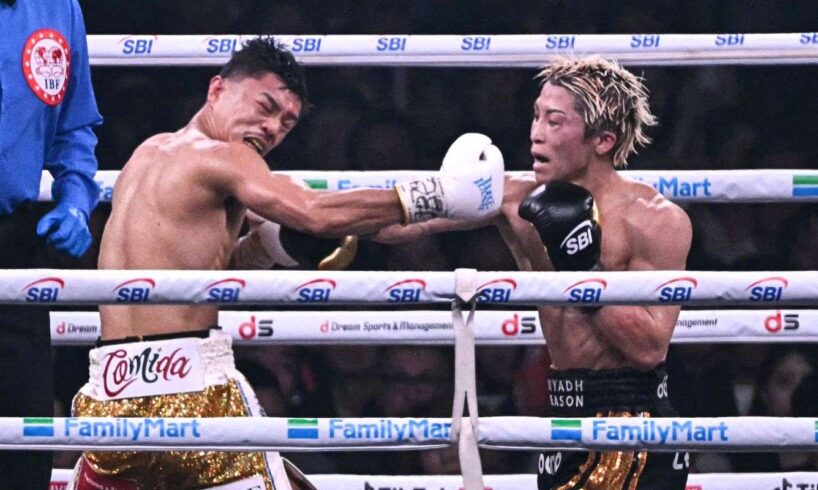

Naoya Inoue retained his undisputed super-bantamweight world title at the Tokyo Dome by beating Junto Nakatani via unanimous decision.
The fight – billed as the biggest in Japanese history – delivered both technical excellence as well as back-and-forth drama, but it was Inoue who further cemented his pound-for-pound credentials with a win on the cards.
At the post-fight press conference, Nakatani offered no excuses in defeat, instead praising his opponent.
“I was fully prepared for this fight against Inoue, so there were no big surprises about how he fought against me. But he was of such championship calibre, and I was impressed by his style of boxing in the ring.”
The fight was one of two halves – cautious early and daring late. It was Inoue who benefited from the tentative work in the opening rounds, with a sharp jab and elite movement to nick the rounds.
Asked why he fought to this gameplan, Nakatani said that he wanted to introduce new tactics as the fight went on.
“Naoya is quite a good learner. He learns a lot in such a short period of time, so I didn’t want to disclose everything that I have in the early rounds. That’s why I fought that way.”
Nakatani came on strong in the second half, particularly in rounds eight, nine and ten. In the tenth, he appeared to have the undisputed champion in trouble with powerful barrages, but a deep cut around his eye saw the eleventh swing back in Inoue’s favour.
It appears that the cut was not the only defining factor, however, as Japanese media is reporting Nakatani left the press conference to be checked at hospital for a suspected orbital floor fracture, potentially caused by one of the thudding uppercuts he took towards the end of the fight.
The break beneath the eye, not uncommon in boxing, can require lengthy recovery, particularly if surgery is necessary. Managed correctly, careers can continue on the same path, as evidenced by Inoue himself, who suffered a similar injury against Nonito Donaire in 2019.