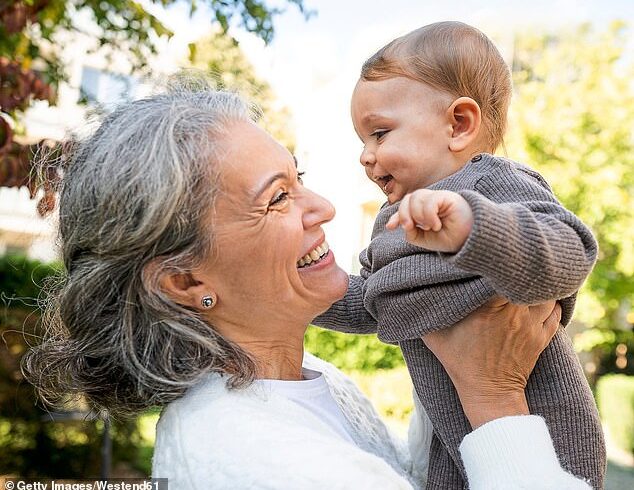
Nobody warns you about this. You’ve got your children through nappies, education, relationships, the search for employment, and they have at last moved out. You don’t get woken in the middle of the night by calls asking for an emergency lift, you don’t find yourself tripping over enormous boat-like shoes in the hallway, and your home is no longer the venue for illicit parties that upset your neighbours. You and your husband are on a second honeymoon, able to enjoy privacy, travel, conversation and each other after more than 20 years of interruptions and crises. At long last, you have your life back!
But then… you find yourself yearning for grandchildren in great, aching pangs.
Feeling broody is perfectly normal in the prime of life. But the longing for grandchildren is a much less well-advertised stage. I call it being ‘groody’.
When did it begin? It certainly wasn’t when my son and daughter went off to university. I missed them, but at the same time I was relieved to have my time to myself. (It’s no coincidence that during this period I started to produce a novel every other year, instead of every four or five.) Then, when I was 58 years old, one of my closest friends became a grandmother and I felt myself suddenly consumed by longing.
I wanted to hold babies again; to listen to their soft, gurgling chat. Even seeing a full-on toddler tantrum and remembering all the sleepless nights didn’t stop the growing feeling that, yes, I’d like a grandchild – or three.
Now, I’m 66 and my children are 30 and 33, and I am so groody that, when my dearest friends – women to whom I wish every good thing – show me videos of their children’s children, I feel both joy for them, and a sickening lurch of envy.

All Amanda Craig’s female friends discuss their yearning for grandchildren with hushed voices
For much of my teens and early 20s, I fought the expectation that girls should have babies rather than careers. But I also love children. When I met my husband at 23, we had no money – but the rising economy of the 1990s meant that ten years later we had a home and our daughter, Leonora. Two years after that, our son Will followed. I have not forgotten the years of broken sleep and stress that came with having a baby and a career, but we Boomers were all ecstatic to be mothers. Even when I had rucksacks under my eyes, I never regretted my children.
Now, all my female friends discuss the yearning for grandchildren in the same hushed voices that we once discussed boyfriends. ‘I have fantasies about replacing my daughter’s contraceptive pills with sweeteners,’ one confesses. Another keeps trying to get her son to hold other people’s babies, ‘because broodiness is catching, and until you’ve held a baby you don’t feel how amazing they are’.
We are nostalgic about our children’s childhood, but a grandchild offers us a second chance at parenting, with all the bad bits left out. You can revel in the sweetness of a baby, a small child and even a teenager – because you know that you will always hand them back.
‘I never really enjoyed my children’s childhood because I was so busy and anxious,’ says my friend Sophie, who had three, and a successful catering business to run. Glowing with happiness, she tells me, ‘With my baby grandson, there isn’t that terror when he screams. I know how to settle him. I feel more confident than I’ve ever felt.’ I was delighted to see her so happy, but I also felt an awful sorrow and fear; I don’t want to miss out on this myself.
We all get it wrong the first time. Most kids turn out fine, but I remember thinking many times as a young mother how much I would enjoy my children if I weren’t so exhausted and stressed – and had a bit more help from my own parents, who as members of a different generation had much stricter attitudes.
But, mostly, I think you start to long for a grandchild once you understand that time is running out – for yourself as well as for them. Children and grandchildren are your little bit of immortality: if you have them, not everything of you will vanish when you die.
‘If my children don’t have children, I feel it’s the end,’ one groody friend tells me, in tears. ‘They don’t understand how lonely they will be when they too are old. My son thinks it’s all about travelling the world and achieving a certain income. But a child is the ultimate adventure, and precisely what an income is for.’
Men feel groody, too. My husband occasionally mutters about how he wishes our kids would ‘stop dithering’ and, now that about half our male friends are coping with prostate cancer, a grandchild is the one thing besides a Freedom Pass that really cheers them up. If working mothers feel they never had enough time to play with their children, it is even more the case with working fathers. It is both poignant and lovely to see retired judges or hospital consultants get down on their stomachs to make choo-choo noises.
I’ve told both my daughter and my son, as gently as possible, that they need to hurry up. Babies never arrive at convenient times; at 35, women’s fertility is said to fall off a cliff; they are going to need to get sprogging before I am too old and tired to help look after them. It doesn’t seem to sink in.
My daughter Leon is preoccupied with her own career as a novelist and is living in Berlin because the housing there is cheaper. She told me that when she was 27 and working in British publishing, she did a spreadsheet to see whether she could ever afford to have a child. She realised she could not, and that is still the case; though she has a serious partner (a woman), she has said very firmly that she won’t be having children. Meanwhile, my lawyer son, though generally keen to have a family with his lovely lawyer girlfriend, still can’t make the eye-watering deposit for a flat that would be within commuting distance of his job. My groodiness comes up against the perfect storm of incomes, careers and property prices.
In my new novel, High And Low, my middle-aged heroine Mary has three adult children, each of whom is living and working abroad because they are unable to get jobs or afford homes in Britain. She’s consumed by groodiness, and I grant her the kind of blessing that only fiction can provide: her dying neighbour leaves Mary her home in her will. It is clear that her eldest child will be moving back from Lisbon to live next door and start his own longed-for family.
I know this is the stuff of fairy tales. Instead, my generation’s hearts are breaking, as our kids’ biological clocks tick down. One friend’s mother-in-law offered him and her daughter unlimited babysitting if they would move from London to rural Wales near her. (They did.) And those who can are raiding pensions and downsizing homes, even if stamp duty and the property slump makes this almost pointless. My husband and I have already given our children the biggest lump sum from our savings that we can manage. And, although we both continue to work, I’ve told my son that if he lives somewhere reasonably close by, I’ll look after any grandchildren at least one day a week.
‘You know, when you were born, we were so broke that we didn’t even have a cot for you. You slept in a blanket-lined drawer,’ I tell my daughter. All this does is convince her that having babies is for millionaires.
I can’t force my children to get on with it any more than I could once force them to eat broccoli. All I will say is that I have bags and bags of my children’s clothes and toys and books in the attic, waiting like eggs to hatch.
High And Low by Amanda Craig will be published on 7 May by Abacus, £20. To order a copy for £17 until 17 May, go to mailshop.co.uk/books or call 020 3176 2937. Free UK delivery on orders over £25.