A federal judge on Monday ruled that the Justice Department illegally fired Maurene Comey, the daughter of former FBI Director James Comey, from her job as a federal prosecutor in New York.
Comey was abruptly fired last July from her job as an assistant US attorney for the Southern District of New York, where she had served for roughly a decade and oversaw some of the department’s most high-profile prosecutions – including cases against Jeffrey Epstein, Sean ‘Diddy‘ Combs, and former Senator Robert Menendez.
Comey sued to challenge her firing, which she argued violated ‘multiple provisions’ of the Civil Service Reform Act – a law designed to protect government employees, including career federal prosecutors – as well as the First and Fifth Amendments of the US Constitution.
The federal judge overseeing the case largely agreed.
US District Judge Jesse M. Furman said in a 55-page ruling Monday that Comey’s termination ‘was not authorized by any statute,’ despite the Trump administration’s arguments to the contrary, and ruled that it was a violation of CSRA, which limits the conditions by which federal workers can be removed from their jobs.
‘Indeed, to accept Defendants’ argument would be to unsettle the very equilibrium established by this Nation’s constitutional system,’ Furman said.

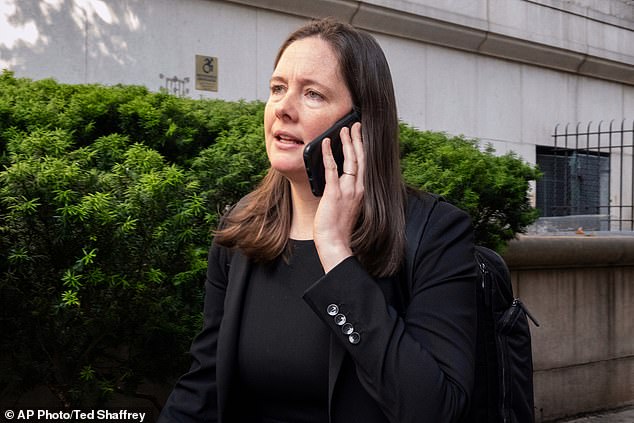
Then-Assistant US Attorney Maurene Comey, the daughter of former FBI Director James Comey, is seen outside federal court before the start of the Sean ‘Diddy’ Combs trial in 2025

President Donald Trump shakes hands with then-FBI Director James Comey in 2017. Trump fired Comey the same year, well before the end of his ten-year tenure at the FBI

Then-Deputy Attorney General Todd Blanche speaks alongside Pam Bondi and Trump. A judge ruled Comey was illegally fired from DOJ, an action the administration said was ‘directed’ by Bondi and later ‘ratified’ by Blanche
The judge further ordered Comey retroactively reinstated to her role, and ordered she be granted retroactive back pay beginning from the date of her firing through December 20, 2025, when she accepted a new job in the private sector.
It is unclear whether Comey plans to return to the Justice Department.
Her lawyers praised the decision Monday as a ‘hard-earned victory’ for Comey and other civil servants, saying in a statement that the outcome ‘reaffirms our bedrock system of checks and balances.’
The ruling caps, for now, months of dispute between the Trump administration and Comey’s daughter, who said she terminated as the ‘direct result’ of Trump’s adversarial relationship with her father, former FBI director James Comey, whom Trump fired in 2017 – well before the end of his 10-year tenure.
Lawyers for the younger Comey argued in her complaint that ‘no plausible’ outside explanation exists for her firing.
The judge, for his part, seemed to agree. Furman noted that Comey had been ‘assigned some of the country’s highest profile cases’ during her nearly 10 years at DOJ, and had ‘consistently received the highest accolades from supervisors and peers alike.’
Comey told her colleagues in a memo last year that she had been ‘summarily fired via memo’ by the Justice Department.
No reason was given, she said, and it was unclear who had made the decision to terminate her.
Trump officials later said her removal from the US attorney’s office was ‘directed’ by former Attorney General Pam Bondi, and ‘ratified’ by Todd Blanche, who assumed the role in an acting capacity beginning in April.
At the time of her lawsuit, Comey noted that Trump had posted, or re-posted more than 250 times about her father on social media, including posts ‘repeatedly’ describing him as the ‘worst’ FBI director in history.
Since the start of Trump’s second term, the Justice Department has brought two separate criminal cases against James Comey – the first, for allegedly making false statements to Congress, and the second, for allegedly threatening Trump by way of an Instagram photo of seashells, arranged to depict the numbers ’86 47.’
The first case was ordered dismissed by a federal judge last year, and Comey has pleaded not guilty in the second case – describing both efforts as the result of ‘vindictive’ and selective prosecutions.