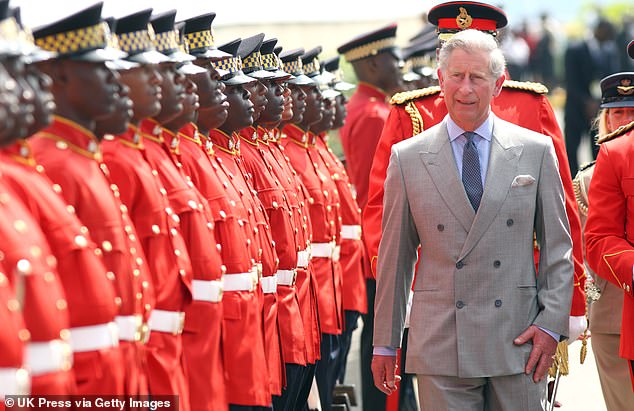
The King won’t apologise for Britain’s role in the historic transatlantic slave trade or offer reparations when he tours the Caribbean later this month.
His Majesty is set to fly into a storm over the issue at the biannual Commonwealth Heads of Government Meeting (CHOGM) in Antigua, with campaigners already warning him ‘not to come empty-handed’.
He is also visiting Guyana and The Bahamas, where the Bahamas National Reparations Committee (BRNC) has urged him to issue a formal apology for the Crown’s own ‘undeniable’ links to slavery.
‘For King Charles to come to our island and not be prepared to apologise for the wrongs of the past is unacceptable,’ its chair Dr Niambi Hall Campbell-Dean has said.
But announcing further details of Their Majesties ‘autumn tour’ today, Buckingham Palace made clear that King Charles would act only on the advice of his government.
Officials at the Foreign, Commonwealth and Development Office (FCDO) confirmed that the Government ‘has not advised His Majesty to apologise or pay reparations’ in line with official policy.
A spokesman said: ‘The Government’s position on reparations is well established. The Government absolutely acknowledges that the transatlantic trade in enslaved people was abhorrent, and that the impacts of that were horrific and do endure to today.
‘The Government has been clear that it will not pay financial reparations.

‘The Government is committed to continue dialogue with Commonwealth partners, and, indeed, the Prime Minister, at the time, committed to that again at the last CHOGM, to meaningful, truthful, and respectful dialogue, and also, we’re committed to working with Commonwealth partners to understand the legacies of the past and to work with them, to build modern, forward looking partnerships that are in all countries’ benefits.’
A Buckingham Palace spokesman added: ‘His Majesty, of course, always acts on the advice of his government as part of our constitutional settlement. He has a long history of engaging on this particular issue and all of the things that he has said at CHOGM and elsewhere in the past, about his personal sorrow, about this particular period of our history, are worth repeating.
‘It’s not just about what His Majesty has said, it’s about what he’s done: the personal support for Commonwealth education programmes since the last CHOGM, and his support, over many decades, for young people through The King’s Trust. This shows that he has always engaged on ways in which the inequalities of the past can be righted.
‘But as far as reparations and apologies go, that is a matter for the Government.
‘And His Majesty always acts on his government’s advice.’
The issue of reparatory justice for former British colonies affected by slavery has been a running sore for decades.
The British Government has remained firm in its opposition to paying any kind of financial compensation, preferring to focus on ‘mutual cooperation’ in areas such as education and economic development.
Campaigners, however, have insisted that the UK will have to pay up eventually.
Now some Caribbean nations are preparing to reignite the issue at the upcoming CHOGM gathering in Antigua and Barbuda in November, which the King and Queen Camilla will attend.
It is anticipated that new British Prime Minister Andy Burnham will join them too, his first diplomatic summit with the British head of state.
Last month Jamaica, another Commonwealth member, also lodged a petition in the UK demanding the monarch seek legal guidance on their own slavery reparations.
They are demanding clarity from the judicial committee of the privy council, the final court of appeal for UK overseas territories and some Commonwealth countries.
Culture minister Olivia Grange said the request was being made of the King in his role as Jamaica’s head of state ‘from whom we expect protection’.
The move follows a landmark United Nations General Assembly resolution adoption in March 2026 which declared the transatlantic trafficking of enslaved Africans as a ‘grave crime against humanity’.
Any reparational justice bill could run into billions of pounds, although some campaigners have suggested that any compensation could take the form of education or climate-focused programmes.
The issue has raised its head before at previous Commonwealth meetings and royal visits, with the King becoming the first senior British royal to explicitly and publicly acknowledge the ‘appalling atrocity’ and historical stain of the transatlantic slave trade during a speech in Barbados in November 2021.
It is understood that he intends to approach the issue in a similar way this year, both through speeches and visiting landmarks with links to the historic slave trade, stopping short of any kind of apology.
A Buckingham Palace spokesman: ‘This year’s CHOGM… comes at an important time in the history of the relationship between the United Kingdom and the countries of the Caribbean in particular. There are important discussions taking place in various fora about colonial legacy and the intergenerational impact of the transatlantic trade in enslaved persons.
‘While these are primarily matters for Governments to address, His Majesty’s previous statements on them have been unequivocal, describing them as an “atrocity” which “forever stains our history.”
‘The visit programme will therefore not shy away from “the darkest days of our past”, as His Majesty has described them, but – in keeping with the wishes of our host nations – it will principally be oriented to the vibrant present and promising future of each country, with visit programmes developed in close consultation with their governments to reflect their individual priorities.
‘That said, it is important to note here the work His Majesty himself has done over many years both to acknowledge the wrongs of the past and to find creative ways to “right inequalities that endure”. As you would therefore expect, opportunities will be found during the visit to reflect and renew his personal, wholehearted, and continuing commitment to that process.’
The King will visit The Bahamas, where he is head of state, from October 27 to 29, then on to Guyana for a two-day State Visit at the invitation of the country’s president.
Guyana is the fastest growing economy in the world and the UK’s biggest trading partner in the Caribbean.
He will then be joined by his wife, Queen Camilla, in Antigua from November 1 to 4.