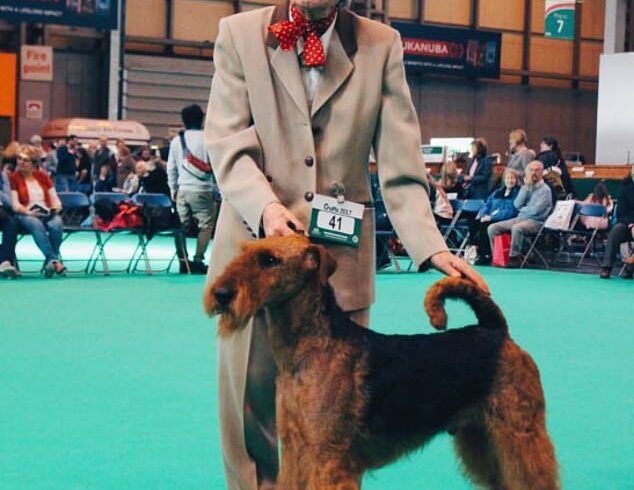
The £1.1million will of a Crufts champion dog breeder is at the centre of a bitter court fight between her son and her old kennel hand, who says she treated him like ‘family’ and promised to look after him for life.
Mary Swash was a world-renowned breeder of pedigree Airedale terriers, with her dogs scooping numerous honours over the decades, including the coveted best-in-show trophy at Crufts in 1986 with her prize pooch Ginger Christmas Carol.
But following her death at 89 in July last year, a row broke out after her loyal kennel hand, David Brand, 59, claimed the £100,000 she left him in her will was insufficient.
Mr Brand worked alongside Mrs Swash for 34 years, devoting his ‘entire adult life’ to her, and was treated like family and was promised he would be looked after for the rest of his life, London‘s High Court heard this week.
The kennel hand lived in accommodation on her Hampshire estate, had all his bills paid and food provided by Mrs Swash, and was given £50 weekly pocket money.
Mr Brand, who says he also stepped forward to help with Mrs Swash’s care in the final year of her life, was left a £100,000 legacy in the dog breeder’s will, with the rest of her £1.1million fortune going to her only son, John Cartledge.
The kennel hand is now suing Mrs Swash’s estate and her son as executor, claiming he deserves ‘reasonable provision’ from her fortune – in a claim that Mr Cartledge’s lawyers say could lead to the entire £1.1million fortune being handed to Mr Brand.
This is despite Mr Cartledge’s ‘generous’ offer to purchase a £300,000 house for Mr Brand from his mother’s estate, and already paying him £350 per month plus estate and dog expenses.

Mary Swash was a world-renowned breeder of pedigree Airedale terriers, and had a large estate in Hampshire

Mrs Swash’s son John Cartledge could now lose his entire inheritance after kennel hand David Brand sued
At a hearing this week, Mr Cartledge agreed to increase the monthly payments to £850 until the case comes to court next year, and pay £1,500 in monthly estate payments – as the judge questioned why Mr Brand was unable to seek employment himself and ‘lauded’ Mr Cartledge’s generosity.
Mrs Swash set up her famous Jokyl kennels in 1959 on her farm in West Tisted, Alresford, Hampshire, going on to breed generations of prizewinning pedigree Airedale terriers.
Her crowning glory came in 1986 when Ginger Christmas Carol – also known by the pet name Emma – took the best-in-show prize at Crufts. Mr Brand is continuing to care for ten dogs, and does not have other employment.
At London’s High Court this week George Woodhead, for David Brand, made an interim application requesting money from the estate for him to live on until the trial of the case next year.
High Court judge Deputy Master Michael Jefferis heard that Mr Brand started living and working with Mrs Swash – caring for her dogs – in 1992 and, having moved into her house is still there now over a year after her death.
He is looking after ten Airedales, six of which belong to her estate and four of his own, and has three female friends who cook for him and ‘bring him cake’.
Mrs Swash’s 2008 will, which she never altered, left £100,000 to Mr Brand and the rest to her son, 63, boss of a pet services business in Bracknell, Berkshire, which was founded by his father Joe Cartledge, also a former Crufts winner with a champion Airedale.
The breeder’s estate consists mainly of her farm, which was valued at £1.1million last December for probate, plus around £70,000 in cash.
She also transferred £7,500 into a ‘dog fund’ before her death, which Mr Brand had been using for canine expenses and which he says has now run out.
In January this year, he lodged a caveat against the will, freezing the assets of the estate and through lawyers informed Mr Cartledge that he intended to bring a claim for a ‘reasonable provision’ payment from Mrs Swash’s estate under the 1975 Inheritance Act, on the basis he was ‘dependent’ on her.
Luke Harris, for John Cartledge, told the judge that he had already been paying Mr Brand £350 a month, as well as providing food for the ten dogs and paying for estate expenses.
He had also offered to settle the whole claim out of court by buying him a £300,000 house with his late mother’s money, which he would have the right to occupy for life, on top of his £100,000 legacy.
The court heard that Mr Cartledge had written an email to Mr Brand’s lawyers, stating: ‘David will not be homeless, I am fully aware of his position and what he meant to mum and it is my duty to make sure he lives comfortably for the rest of his life.’

Mrs Swash won the coveted best-in-show trophy at Crufts in 1986 with her prize pooch Ginger Christmas Carol

Mrs Swash’s farm in West Tisted, Hampshire, where she bred award-winning dogs for decades
But lawyers for David had earlier this month ‘asserted for the first time that it was highly likely [when calculated]… that his lifetime needs exceed the entire net value of the estate’, said Mr Harris.
Asking the judge for either a £50,000 lump sum or £865 a month from the estate leading up to trial, Mr Woodhead for the kennel hand said: ‘David is fast running out and by Christmas, if not sooner, he will have no money. He is in immediate need. He shouldn’t have to rely on the goodwill of Mr Cartledge, which we say is insufficient.
‘He is facing winter with little money, which he sees diminishing. He relies on three female friends to cook for him and bring him cake.
‘My client is scared for the next few months. He is looking after ten dogs. The £350 a month offered will run out and he may not be able to feed himself or the dogs by midwinter, and then what?
‘We have here a 59-year-old man in poor health who should not have to rely on the goodwill of a man who is contesting his standing to bring this claim.
‘Mrs Swash provided him with his home in the kennels, paid all his bills, for his food and his vehicle, plus £50 a week pocket money. She provided David with everything.
‘It was almost like the provision that a parent might provide for a teenage child.
‘It is said against us that David was just an employee, but there was never a wage paid to David and there was no contract.
‘David’s evidence is that Mrs Swash referred to him as being family in all but blood,’ he said, adding that David had ‘provided devoted care towards the end of her life’ for Mrs Swash, alongside a professional carer.
‘He is a man who handles dogs and has done so for all his working life,’ he continued.
‘These are two people who were devoted to caring for a particular breed of dogs. They were the best in the business.
‘Mary wished him to have a property to live in for as long as he wishes and the means to support himself… Mary’s wishes were that David would be looked after.’
He added that the £300,000 offered by John would not pay for a suitable property, as Hampshire is expensive.
‘He wants to stay in the region. He has a fairly narrow existence. This was his world,’ he added.
At the end of a half-day hearing, Mr Cartledge, who didn’t attend personally, agreed an undertaking to up David’s monthly payments to £850, having already been paying £350 a month, plus paying around £1,500 a month in estate expenses, including providing food for the dogs.
Referring to the £300,000 accommodation offer, his barrister told the judge that Mr Cartledge had been keen to avoid court.
‘It is unusual in this kind of case for there to have been an open offer to settle proceedings,’ he said.
‘The claimant will potentially exhaust the whole of the estate. On his own prediction, the claim may be advanced on the footing that his needs exceed the whole net estate.
‘John has potentially no economic interest in the estate, given the way the claim is now being put.
‘David is making a claim for potentially the whole of the estate.’
Master Jefferis, accepting Mr Cartledge’s undertaking, said: ‘As I understand it, Mr Cartledge has been trying to do a deal and Mr Brand has been saying “no”.
‘I do have the feeling that [John] has been quite generous,’ he added.
‘The defendant should be lauded for recognising that he has a responsibility to look after the claimant.
‘In my judgment, this was not a commercial relationship. £50 pocket money was paid. This was an informal arrangement that ran for 34 years.
‘Mrs Swash spoke about him as if he were a member of the family and said that she was hoping to buy him a house and get him settled so that if she died he would be looked after.
‘I do find that there is a strong claim and that the claimant is in immediate need,’ he said.
Approving the undertaking however, the judge commented: ‘I think that the £850 a month figure is probably on the generous side.
‘I have not been told why Mr Brand can’t get another job and why looking after ten dogs is a full-time occupation and why the estate dogs can’t be sold.’
Household and estate dog expenses will be met out of the additional £1,500 estate expenses payments, the judge said.
Earlier in the hearing, David’s lawyers had said in response to suggestions that some of the dogs be disposed of: ‘The dogs are his companions. To simply rehouse them would be a cruel imposition on him. This is his life.’