Sea views at one of Britain’s biggest holiday resorts have been blocked by foliage and overgrown hedges after a council’s green initiative led to petrol strimmers being swapped for a less effective machine – mountain goats.
Bournemouth’s goats, which have their own landmark as a ‘tourist attraction’ on Google Maps, have been a regular sight on East Cliff since a herd was introduced by the council officers in 2019.
But while the four-legged locals are beloved by many, they have reportedly done a poor job at trimming back the clifftop foliage.
The council said most ‘vegetation cutting’ takes place during the winter to avoid disrupting wildlife during the bird nesting season, and when tourist numbers are lower.
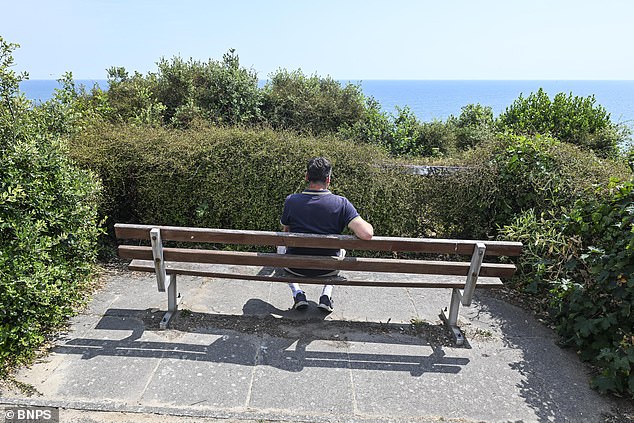
The foliage has since grown out of control and blocked walkers’ views from the top of the East Cliff, which used to offer views of the sandy beach below and Poole Bay beyond.
Tourists are now greeted with a wall of bushes and thick gorse when they stand or sit on one of the benches at the top of the 100ft cliff to look out to sea.
Bournemouth, Christchurch and Poole Council (BCP Council) had declared a climate emergency in 2019 and brought in grazing goats in the hope they would manage the cliff-side vegetation instead of petrol-powered strimmers.
But it seems the herd of mountain goats is unable to cover the whole cliff, and as a result the foliage has massively overgrown in some parts.

Those looking for sea views might struggle along Bournemouth’s East Cliff, after the cliff foliage became overgrown

Goats have been a regular sight on Bournemouth’s East Cliff since a herd was introduced by council officers in 2019

The goats have become something of a tourist attraction since being introduced in 2009 and even have their own social media accounts

The clifftop has been managed by a herd of mountain goats since 2019, after the council replaced petrol strimmers with the animals
Jo Keeling, of the campaign group BCP Community Action, said: ‘Everywhere seems to be so overgrown. We are a tourist town and rely on tourists and first impressions matter.
‘But when you have a prime area of the seafront looking unkempt and untidy it is going to put people off.
‘We are gifted with a beautiful coastline and yet part of it looks like this… I just don’t get the lack of foresight into how this is putting people off coming here.
‘People take pride in where they live or where they visit and we rely on tourism. If they see somewhere that looks smart and tidy they are inclined to keep it that way – and the same can be said if somewhere looks scruffy and unkempt.’
Visitor Simon Wilson, from Birmingham, said: ‘There are loads of tourists staying in hotels on East Cliff and rather than the beach and the sea, the first thing they see when they step outside is overgrown bushes blocking the view.
‘It seems so obvious. The reason people come to Bournemouth is the beach, why would you not want to show it off from every vantage point?’
Councillor Andy Hadley, BCP Council Cabinet Member for Climate Response, Environment and Energy, said: ‘Vegetation on Bournemouth’s cliffs is carefully managed to maximise benefits for local wildlife while preserving access and key viewpoints where possible.
‘To minimise disruption to wildlife, most vegetation cutting takes place during the winter months, outside the bird nesting season, when visitor numbers are lower and access is easier for maintenance teams.

The herd of around 50 goats reside on a seven-mile stretch of cliffs in Bournemouth

The goats are gated in the grassy section of the cliff, which sits 100ft above the beach below

Campaigners have said the popular holiday resort’s tourism sector will be affected if visitors are greeted with the overgrown foliage
‘The cliffs are managed using a range of methods, including conservation grazing by goats, which help control vegetation growth and support the special habitats and wildlife found along our coastline.’
A spokesperson has previously stated the benefit to the environment of not cutting back grass and gorse.
They said: ‘We declared a climate and ecological emergency in 2019 and, as part of our response, introduced changes to the management of some green spaces and verges across BCP, as many other Councils have.
‘Allowing selected areas to grow to maturity helps support wildlife and increase biodiversity, while we continue to maintain spaces that are safe and accessible for leisure and dog walking.
‘We aim to strike a balanced approach that benefits both residents and nature, while making the best use of available resources.’